
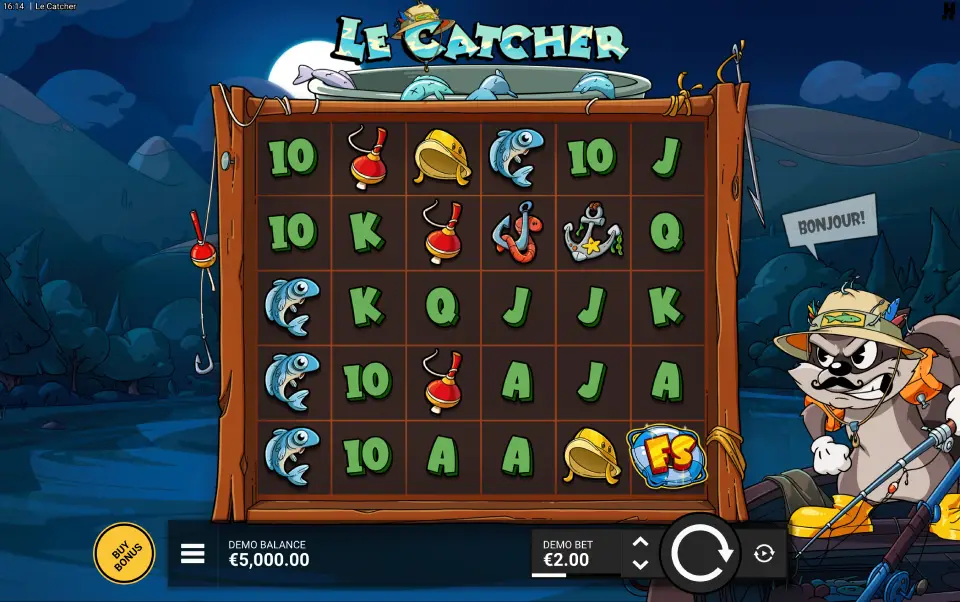
Le Catcher Strategy Guide - Bankroll, Bet Sizing & Tips
Le Catcher strategy starts with one number you control completely: your stake. The slot, released by Hacksaw Gaming on 14 May 2026, runs a high-volatility math model with a published RTP near 96.21%, which means the house edge is fixed no matter how you bet. What strategy actually changes is session length, swing size and how long your bankroll survives a dry run.
This guide is built for skimming. Five decision points you face every session, a low-risk versus high-risk breakdown, bankroll rules with real stop-loss math, and how to turn free play into a working simulator. No winning systems, because none exist on an RNG slot. Just the choices that keep you in control.
Le Catcher Strategy: 5 Decision Points Every Session
-
Set your session budget first
Decide the cash you can lose before you open the game, not during it. Treat it as an entertainment cost, separate from rent or bills.
-
Size bets against the bankroll
On a high-volatility slot, a stake of 0.5–1% of your session budget gives you 100–200 spins. That is enough cushion to ride dry spells between feature hits.
-
Pick your risk lane and hold it
Choose flat betting or a controlled high-risk plan before spin one. Switching stakes mid-tilt is the fastest way to blow a budget.
-
Decide your bonus-trigger appetite
Chasing the feature costs spins. Read the <a href="/scatter-feature/">5-scatter bonus Le Catcher</a> odds first so you know the trigger is rare and never "due".
-
Set a stop-loss and a win goal
Write two numbers down: the loss that ends the session and the win that banks profit. Half your budget down or double it up are common, simple lines.
-
Walk away when a limit hits
When either number triggers, close the game. The RNG has no memory, so a "hot streak" is not a reason to keep pushing past your plan.
Low-Risk vs High-Risk Betting on Le Catcher
Low-risk (flat, 0.5–1% stakes)
High-risk (larger stakes)
Bankroll Management for Le Catcher Sessions

Any honest Le Catcher strategy lives or dies on bankroll math, not bet patterns. The RTP near 96.21% means that over a very large sample, the game returns about 96.21 cents per euro staked and keeps the rest. You can read the full breakdown on the Le Catcher RTP page, but the planning takeaway is simple: every spin carries the same fixed edge, so your only real lever is how you slice the money you brought.
Split your bankroll into session budgets. If you sit down with €100 for the week, four €25 sessions beat one €100 marathon, because each session gets its own stop-loss and its own clean head. Inside a session, a 100x-spin rule works well on high-volatility games: bankroll divided by 100 gives a stake that survives the long gaps between paying spins.
Le Catcher Bet Sizing (Apuestas)
Scaling your bets to the budget is the core of smart apuestas on Le Catcher. A €25 session at €0.20 per spin buys roughly 125 spins; the same €25 at €1.00 buys 25. High volatility punishes the second player far more often, because the long stretches with no feature drain a small bankroll fast. Pick the stake that survives a bad run, not the one that maximises a good one.
Set the two hard numbers before you start: a stop-loss (often half the session budget) and a win goal that banks profit and ends play. If a welcome offer can stretch your starting balance, compare the best deals for Le Catcher before depositing, then read the wagering terms so you know what the bonus actually requires. Bankroll rules reduce damage on a losing session and lock in a good one. They do not beat the house edge, and no staking plan can.
Using the Demo as a Strategy Simulator

Free play is the cheapest testing tool you have. Before risking a cent, run a few hundred demo spins to feel how often the feature hits, how deep the dry runs go, and how your chosen stake holds up. You can open Le Catcher free play instantly with no deposit and treat it as a sandbox for the exact bet sizing you plan to use for real.
Le Catcher Simulator: What Free Play Actually Tests
Used as a Le Catcher simulator, the demo shows you the rhythm of the game on play-money credits. Set the demo balance to mirror a real session budget, pick your real stake, and play it out. Count how many spins pass between meaningful wins. That number, not a gut feeling, tells you whether your stake is too aggressive for the volatility. The one thing the demo cannot do is predict your real session, because each spin is independent.
Is There a "Fake" Le Catcher to Worry About?
The "fake Le Catcher" worry usually means one of two things: a cloned game on an unlicensed site, or the belief that demo mode is rigged to pay more than the real game to lure deposits. On a licensed casino, the demo and the cash version run the same certified RNG and the same RTP; the maths does not switch when you log in. The genuine risk is playing a copy on a site that is not the operator. Stick to the casinos linked here, confirm the provider is Hacksaw Gaming, and the game you test is the game you play. No tool, demo or paid, can manipulate the outcome of a future spin in your favour.
Frequently Asked Questions
Is there a winning strategy for Le Catcher?
No staking system can beat the fixed house edge of an RNG slot. A Le Catcher strategy can only manage your bankroll, control session length and lock in stop-loss and win-goal limits. It improves discipline, not the odds.
What bet size should I use on Le Catcher?
On a high-volatility game, a stake of about 0.5–1% of your session budget is sensible. A €25 session at €0.20 per spin gives roughly 125 spins, enough to absorb the long gaps between feature hits without burning out early.
Can the demo be used as a Le Catcher simulator?
Yes. Set the play-money balance to match a real session budget, use your real stake, and count the spins between wins. It teaches you the game's rhythm cheaply, but it cannot predict any future cash session.
Does Le Catcher pay less after a big win?
No. Each spin is independent and the RNG has no memory of past results. The slot is not "cold" after a payout or "due" after a losing run. Treat every spin as a fresh, isolated event.
Should I chase the 5-scatter bonus?
Chasing the trigger costs spins and money, and the bonus is rare by design. Check the scatter feature odds first so you know it is never guaranteed, and only play within a budget you set in advance.
Is the free demo rigged differently from real play?
On a licensed casino, the demo and the cash version run the same certified RNG and the same RTP near 96.21%. The maths does not change when you deposit. The real risk is a cloned game on an unlicensed site.
Test Your Le Catcher Plan, Then Play
Run your bet sizing in free play first, set a stop-loss, and only deposit a budget you can afford to lose.