
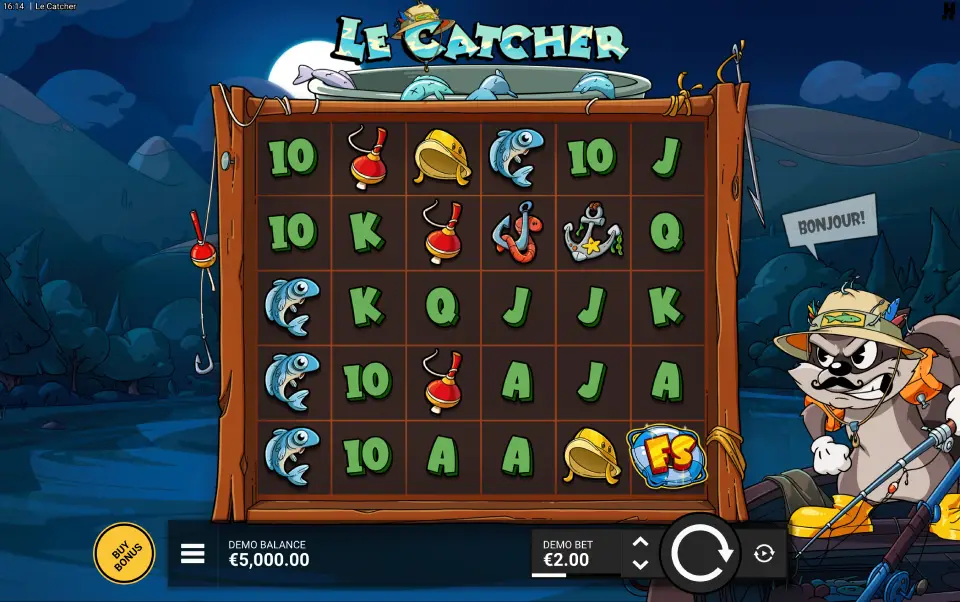
Le Catcher RTP & Volatility - Math Model Explained
96.21% is the headline number on Le Catcher, the default return-to-player Hacksaw Gaming ships with this cluster-pays release from 14 May 2026. That figure tells you the long-run theoretical payback across millions of spins, not what one session hands you. The gap between the two is the whole story on a high-volatility slot, and it's where most bankroll mistakes start.
This page breaks the math down piece by piece: what the RTP percentage actually returns, how the high variance tier changes hit frequency, and how to size stakes around both. For the full feature rundown and theme detail, the Le Catcher slot review covers the rest. Here, the numbers do the talking.
| Provider | Hacksaw Gaming |
|---|---|
| Release date | 14 May 2026 |
| RTP (default) | 96.21% |
| Volatility | High |
| Mechanic | Cluster pays |
| Grid layout | 7×7 grid |
| Hit frequency | ≈ 25–30% of spins |
| Max win | Up to 10,000× the bet |
| Bet range | €0.10 – €100 |
| Game type | Video slot |
Le Catcher RTP: What the Percentage Actually Means

Le Catcher RTP of 96.21% means the game is built to return €96.21 for every €100 wagered, measured across the full statistical sample Hacksaw Gaming uses to certify the math. The 3.79% house edge is the operator's long-run margin. Over a single evening of 500 spins, you will land almost anywhere on the curve, because variance dominates short samples. RTP is a horizon figure, not a session forecast.
Le Catcher slot RTP in real sessions
The Le Catcher slot RTP reads cleanly on paper and behaves messily in practice. Cluster-pays maths front-loads a lot of the theoretical return into rare, oversized cluster hits rather than steady small wins. So a player can run 200 spins and see returns well under 96%, then claw it all back in one cluster cascade. The percentage only converges toward 96.21% as the spin count climbs into the tens of thousands.
Le Catcher slot RTP from Hacksaw Gaming: watch for cut versions
Hacksaw Gaming publishes 96.21% as the default, but operators can request reduced RTP builds, and several Hacksaw titles ship in lowered configurations at certain casinos. Always open the in-game info panel before you stake real money and read the RTP line there. If it shows anything below 96.21%, you're on a cut version, and the house edge has widened. A one-point drop to 95% adds roughly a third more to the long-run cost of play. Confirm the build first, then move on to practical staking in our Le Catcher tips and strategy guide.
Volatility & Hit Frequency: What Kind of Slot Is This?

Le Catcher volatility lands firmly in the high tier, which is the defining trait of how this slot pays. High variance means winning clusters arrive less often but carry more weight when they do. With a hit frequency in the 25–30% range, roughly one in four spins returns something, yet a large share of those returns are sub-stake nibbles that don't cover the bet. The real money sits in the heavy-tailed cluster cascades that show up far less frequently.
What Le Catcher slot volatility feels like over a session
The Le Catcher slot volatility profile produces long dry stretches punctuated by sharp spikes. Observed play data backs this: across recent tracked bets, the average winning multiplier sat near 44× while the win rate hovered around 33–35%. Read together, those two numbers describe exactly what high variance does. Wins are uncommon, but when a cluster chains, the payout dwarfs a dozen flat spins. Expect drawdowns. A bankroll that survives 150 blank spins is a bankroll that's still in the game when a cluster lands.
Because the swings are steep, the smart move is to feel the variance with no money on the line first. Le Catcher free play runs the same math model as the real game, so you can watch how often clusters trigger and how brutal the cold runs get before you commit a deposit. A few hundred demo spins teaches the rhythm faster than any spec sheet. High volatility rewards patience and punishes chasing.
Bankroll Planning Based on RTP & Variance

Start with one rule of thumb: on a high-volatility slot returning 96.21%, your stake should be small enough to absorb 200 to 300 losing spins without busting. That's the practical translation of the math. At a €1 spin, a 300-spin buffer means a €300 session bankroll, which sounds steep until you account for how long the dry runs stretch on this game. Drop to €0.20 spins and the same €60 carries you the same distance.
A workable framework looks like this:
- Session bankroll: at least 200× your spin bet, ideally 300× for the cluster droughts.
- Spin bet: keep it at or below 1% of your total bankroll, so no single cold streak ends the night.
- Loss limit: set a hard stop before you spin and walk when you hit it, win or lose.
- No bet-chasing: raising the stake after a losing run does not change the 3.79% edge, it just burns the bankroll faster.
The theoretical max win sits up at 10,000× the bet, but that ceiling is a statistical rarity, not a target. Real outcomes cluster far lower, as the spread of recorded payouts shows in our biggest Le Catcher wins breakdown. Plan around the median experience, not the dream spin. No RTP figure and no staking plan guarantees a profit, and high-variance maths means you can lose the lot in a session that never catches a cluster. Stake only what you can comfortably write off, and treat any large hit as a windfall rather than an expectation.
Frequently Asked Questions
What is the RTP of Le Catcher?
The default Le Catcher RTP is 96.21%, the figure Hacksaw Gaming certifies for the standard build. Some operators run reduced-RTP versions, so check the in-game info panel before staking to confirm which configuration you're playing.
Is Le Catcher high or low volatility?
Le Catcher is a high-volatility slot. Winning clusters arrive less often but pay more when they land, which produces long quiet stretches broken by occasional sharp spikes. It suits patient bankrolls, not short bursts of play.
How often does Le Catcher pay out?
Hit frequency sits roughly in the 25–30% range, so about one spin in four returns something. Many of those returns are smaller than the stake, with the meaningful payouts coming from rarer cluster cascades.
Can the RTP be different at some casinos?
Yes. Hacksaw Gaming offers operators the option to deploy lower RTP builds, and several of its titles run in cut versions at certain sites. Always read the RTP line in the game's info panel; anything below 96.21% means a reduced configuration and a wider house edge.
What bankroll do I need for Le Catcher?
For a high-variance slot like this, plan for 200 to 300 times your spin bet so the bankroll survives long losing runs. Keeping each spin at or under 1% of your total balance gives the math room to even out.
Does a higher RTP guarantee I'll win?
No. RTP is a long-run theoretical figure measured over millions of spins. Over a single session, variance dominates and you can lose your full balance regardless of the percentage. Stake only what you can afford to lose.
Put the Math to the Test
Spin Le Catcher at 96.21% RTP and see how the high-variance cluster model plays out for yourself.